What Is Trade Review
What trade review is
Trade review is the feedback loop of trading. You record what you did, measure it, and look for patterns in both your mistakes and your good execution. The point is not to relive wins and losses. It is to turn a pile of trades into information you can act on.
The daily review and the longer review answer different questions. The daily review looks at execution. Did you follow your plan today, and where did you break from it. The weekly or monthly review looks at the numbers, once you have a sufficient sample size. Expectancy and the rest only show up over a sample, so a single day tells you whether you executed, not whether the edge is real.
Why review matters
Without review, two things stay hidden. You cannot tell whether your strategy has positive expectancy, and you cannot tell whether your execution is leaking the edge it has. The same costly mistakes repeat because nothing is measuring them, and the gap between your edge and your results stays invisible.
Review closes that gap. It shows what is working, where execution breaks down, and what to adjust. Mistakes get caught earlier and good behavior gets reinforced. Over a large enough sample, this is what lets a real edge show up in your actual results.
Judge execution, not the result
The money a trade or a day made is not the score. Whether you followed your plan is. Markets are probabilistic, so a good trade can lose and a bad trade can win. Judging by profit and loss rewards the lucky deviation and punishes the clean trade that happened to lose, which trains the wrong habits.
A trade is clean when every decision in it followed your written plan. It is a deviation when any decision did not. Being wrong while following your plan beats being right while deviating, because following the plan is what lets your edge show up over a sample, while a deviation that won only teaches you to trust the next one. Scoring this way separates your execution from your strategy edge. If execution is clean and results are still poor over a sufficient sample, the strategy is the suspect. If deviations are frequent, the edge has not had a fair test yet.
Review the day with a report card
At the end of the session, reflect on how you executed, not on what the day made. A daily report card gives that reflection a fixed format, so you fill the same fields every day and can compare one day to the next.
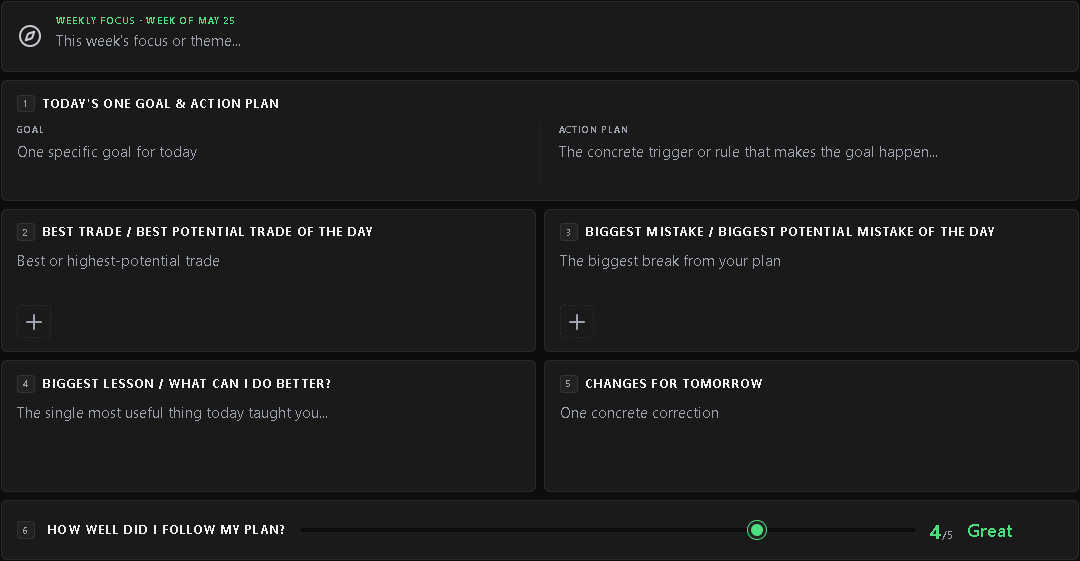
Each field does a job. The week's focus sets the one theme you are working on. The day's one goal and action plan names a single process goal and the concrete rule that makes it happen. The best trade and the biggest mistake capture your cleanest execution and your biggest break from the plan. The biggest lesson names what the day taught, and the change for tomorrow turns that into one correction. The plan-adherence rating grades the day on process, not on profit. Fill it every day, including slow days, because the quiet days often hold the patterns worth catching.
When you broke the plan, ask why and write the fix
Noticing that a rule got broken changes nothing on its own. The improvement is in the next two questions. Why did the rule break, and what is the one change that prevents it next session.
The why is a trigger or a mechanism, not a scolding. Take a real case. I moved a stop on a losing trade. Why. I had not written the exit before entry, and the position size made the loss feel too big to take, so the survival brain took over. The fix writes itself from there. Put the stop on the ticket before entry, and size down until the planned loss is small enough to accept. One trigger, one fix.
Carry that single change into the next session as your action plan, then check tomorrow whether you acted on it. This is the part you control. Improvement is a choice you make on purpose, day after day, not something that happens to you over time.
Review the numbers over a larger sample
This is the longer review. Once you have a sufficient sample size, usually 100+ trades, you check the numbers to judge the edge. A few core metrics carry most of the signal. Read them over the sample, not day to day, because on a handful of trades they are mostly noise.
- Expectancy. The average result per trade. The number that tells you whether the strategy makes money.
- Win rate. The share of trades that win. One input into expectancy, not an edge on its own.
- Profit factor. Gross profit divided by gross loss. Above 1 means the wins outweigh the losses over the sample.
- Drawdown. The fall in the account from a recent peak. It shows how deep the losing stretches get before a new high.
How to start
Start with two habits you can keep. End each day with a short report card scored on plan adherence, even on the days you took no trades. Then on a weekly or monthly cycle, once you have a sufficient sample size (100+ trades), review the numbers across the sample. Expectancy, win rate, profit factor, and drawdown.
Keep the two apart. The daily review judges execution and works on any number of trades. The longer review needs the sample before expectancy means much, so do not read the edge off a few days. A review you do every day beats a detailed one you abandon.
Common mistakes
- Judging the day by profit and loss. A green day with sloppy execution is a problem waiting to repeat, and a red day of clean trades is often fine. Score the process first.
- Reviewing only after big days. A review you only do after a large win or loss has gaps. The ordinary days hold most of the patterns.
- Stopping at "I broke my plan". Naming the mistake is not the work. Asking why and writing one fix for tomorrow is.
- Reading the edge off a few days. Expectancy and the numbers only mean something over a sample of around 100 trades. A handful of days is too few to judge the strategy, only how you executed.
Frequently asked questions
What is trade review?
Trade review is measuring your trades so you can improve them. You do it daily and over a longer cycle. The daily review judges your execution, whether you followed the plan, and the weekly or monthly review checks the numbers once you have a sufficient sample size (100+ trades).
How do I review my trading day?
At the end of the session, score how you executed, not what the day made. Note your best trade, the biggest break from your plan, the lesson it taught, and one change for tomorrow, then rate how well you followed your plan. A daily report card keeps those fields in the same shape every day.
What is a daily report card?
A daily report card is a fixed end-of-day reflection on your execution. It holds the week's focus, the day's one goal and action plan, the best trade, the biggest mistake, the biggest lesson, the change for tomorrow, and a rating for how well you followed your plan. It grades the day on process, not profit.
What should I do if I did not follow my plan?
Do not stop at noticing it. Ask why the rule broke, which is usually a trigger or a missing rule, then write one concrete change that prevents it next session. Carry that single fix into tomorrow and check whether you acted on it.
What should I track in a trade review?
Track expectancy, win rate, profit factor, and drawdown, and read them over a sample on a weekly or monthly cycle rather than day to day. The daily review is a separate job that scores whether each trade and each session followed your plan. The numbers show the result, plan adherence shows the execution behind it.
How often should I review my trades?
Review your execution every day, including slow days, since that builds the habit and catches patterns early. Review the numbers on a longer cycle, weekly or monthly, because expectancy and the edge only show up over a sufficient sample size (100+ trades).
Key takeaways
- Trade review runs daily for execution and weekly or monthly for the numbers.
- Judge execution on whether you followed the plan, not on whether money was made or lost.
- A daily report card scores the session on execution and carries one fix into tomorrow.
- When a rule breaks, ask why and write one concrete change. Do not stop at noticing it.
- Read expectancy, win rate, profit factor, and drawdown over a sample, on the longer cycle, not day to day.
Make review a daily habit
Trader Dashboard tracks your expectancy, win rate, profit factor, and drawdown from your logged trades, and includes a daily report card to score the session on plan adherence and carry one fix into tomorrow. Access it with a Trader Dashboard subscription.