What Is a Trading Edge
What a trading edge actually is
An edge is the reason a strategy makes money over time. More precisely, it is a measurable advantage defined by the relationship between three numbers. Win rate, average win, and average loss. When those numbers combine to a positive average result per trade, the strategy has an edge. When they do not, it does not, no matter how good any individual trade felt.
The key word is measurable. A feeling that a setup is strong is not an edge. An edge is something you can calculate from your own trade history and check. If you cannot point to the numbers, you do not yet know whether you have one.
Why an edge only shows up over a large sample
A single trade tells you almost nothing about whether a strategy works. Good setups lose and weak setups sometimes win, so any one result is mostly randomness. Edge only becomes visible once randomness averages out across many trades.
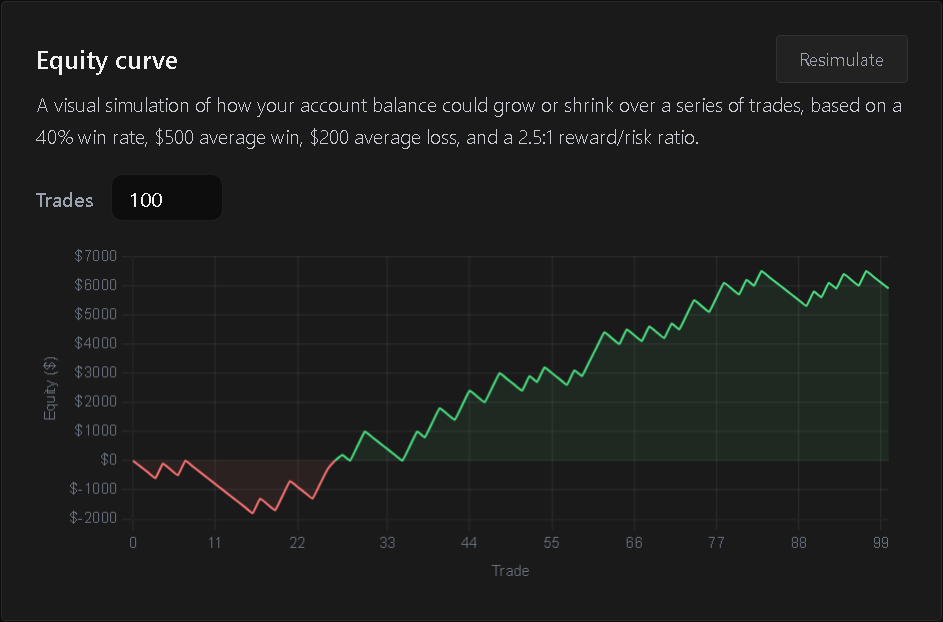
Rough sample-size thresholds help here. Ten or twenty trades are noise and support no conclusion. Around 50 trades can start to reveal an early pattern. Around 100 trades on the same rules is a practical floor before you judge whether a strategy has an edge. This is why reacting to the last three trades is a mistake. The sample is far too small to carry the signal.
How expectancy measures your edge
Expectancy is the numerical expression of edge. It is the average amount you can expect to make or lose per trade over a large sample.
Run an example. Say a strategy wins 40 percent of the time, the average win is $600, and the average loss is $300. That is (0.40 × $600) − (0.60 × $300), which is $240 − $180, or $60 per trade. The expectancy is positive even though the strategy loses 6 trades out of every 10. That is what an edge looks like in dollars. You can test different numbers with the free trading expectancy calculator, and the deeper guide on what expectancy is walks through it in full.
An edge is not the same as a high win rate
A high win rate is not an edge on its own. The example above wins under half its trades and still makes money, because the average win is twice the average loss. The reverse is also true. A strategy can win 90 percent of the time and still have negative expectancy if the few losses are large enough to wipe out the many small wins.
This is why win rate alone is misleading. Edge is the combination of how often you win and how much you win versus lose. Judge the strategy by expectancy over a sample, not by the win rate by itself.
Where an edge comes from
An edge is the emergent result of your whole trading process working together, not a single trick. It comes from a clearly defined strategy, consistent risk management, disciplined execution, and ongoing review. Weakness in any one of those layers reduces the edge the others produce.
So an edge is earned, not found. It appears when a tested set of rules is applied the same way across a large enough sample for the math to express itself.
Common mistakes
- Judging the edge on a few trades. Abandoning a strategy after three or four losses reacts to noise. Edge needs a sample of roughly 100 trades before the result means much.
- Treating win rate as the edge. Win rate is one input. Without the average win and average loss, it says little about whether the strategy makes money.
- Calling a feeling an edge. If you cannot calculate expectancy from your own logged trades, you have a hypothesis, not a measured edge yet.
Frequently asked questions
What is an edge in trading?
An edge is a measurable advantage that makes a strategy produce positive results over a large sample of trades. It is defined by win rate, average win, and average loss, and it is measured by expectancy. It does not exist in a single trade.
How many trades do I need to know if I have an edge?
Around 100 trades on the same rules is a practical floor. About 50 trades can show an early pattern. Ten or twenty trades are noise and cannot tell you whether the strategy has an edge.
Is a high win rate an edge?
Not on its own. A strategy can win under half its trades and still have an edge if the average win is larger than the average loss. A high win rate with large losses can still have negative expectancy.
Can I have an edge and still lose for a while?
Yes. Even a strategy with positive expectancy goes through losing streaks and drawdowns. That is normal statistical behavior, not a sign the edge is gone.
Key takeaways
- An edge is a measurable advantage that makes a strategy profitable over a large sample, not in one trade.
- Expectancy is the number that measures your edge, from win rate, average win, and average loss.
- Win rate alone is not an edge. A sub-50 percent win rate can still be profitable.
- Judge an edge over roughly 100 trades, not over the last few results.
See your real edge in the numbers
Trader Dashboard calculates your expectancy, win rate, and profit factor from your logged trades, so you see whether your edge is real instead of guessing. Access it with a Trader Dashboard subscription.